The answer is YES — with a valid CITES Permit, and Bangkok Bootery takes care of everything for you.
🐊 Bangkok Bootery – International CITES Permit Service
At Bangkok Bootery, we specialize in luxury exotic leather goods made from premium, ethically sourced materials. As part of our commitment to legal and responsible trade, we follow the international CITES agreement (Convention on International Trade in Endangered Species of Wild Fauna and Flora) to ensure your purchase can travel safely and legally across borders.
✈️ Free CITES Permit with Your Purchase
To support our international customers, we are pleased to offer:
✅ FREE CITES Permit for every purchase over 5,000 THB
Whether you’re carrying the item with you (Tourist Permit) or having it shipped to your home (Shipment Permit), we’ll handle the CITES documentation at no extra cost for qualifying purchases.
📌 Two Types of CITES Permits We Offer
1. CITES Tourist Permit (Personal Carry)
For customers bringing exotic leather goods home in their luggage. We issue a tourist export permit proving legal origin. Fast, simple, and ideal for most travelers.
Python Crocodile Crocodile Model
2. CITES Shipment Permit (Courier Delivery)
For customers choosing to have their purchase shipped internationally. We handle export paperwork for a smooth customs process.
Python Crocodile
**On document purpose number 5. There is a letter used on CITES permits and certificates to indicate the purpose of trade in the specimen covered therein, as follows:
Mostly common we are given to our customer as Bold.
T Commercial
Z Zoo
G Botanical garden
Q Circus or travelling exhibition
S Scientific
H Hunting trophy
P Personal
M Medical (including biomedical research)
E Educational
N Reintroduction or introduction into the wild
B Breeding in captivity or artificial propagation
L Law enforcement / judicial / forensic
🌍 Do You Need a CITES Permit for Your Country?
Some countries have strict rules on importing exotic leather products, even for personal use. We recommend checking your country’s import rules before travel.
You can find official CITES authority contact details by country on the CITES website:
🔗 CITES National Contacts & Requirements:
https://cites.org/eng/cms/index.php/component/cp
https://cites.org/eng/disc/what.php
🌍 Country-Specific CITES Import Requirements
Import regulations for exotic leather products vary by country. Below is a summary of requirements for select countries:
Countries Requiring Both CITES Export and Import Permits:
United States: Requires a CITES export permit from the country of origin and may require an import permit for certain species.
Canada: Requires a CITES export permit and may require an import permit for certain species.
United Kingdom: Requires both export and import permits for CITES-listed species.
Singapore: Requires a CITES export permit and may require an import permit for certain large leather products.
Countries with Specific Personal Effects Exemptions:
Australia: Allows import of up to four personal items made from crocodile or alligator leather without an import permit, provided they are for personal use.
Japan: Permits import of up to four personal items made from crocodile or alligator leather without an import permit, provided they are for personal use.
Countries with Strict Import Controls:
China: Requires both CITES export and import permits, even for personal items.
New Zealand: Requires both CITES export and import permits, even for personal items.
Note: Regulations can change, and additional documentation may be required depending on the specific species and product. We recommend that customers consult their national CITES Management Authority for the most current information.
🔗 Resources for Customers
CITES National Authorities Directory: Find contact information for your country’s CITES Management Authority.
https://cites.org/eng/cms/index.php/component/cp
Species+ Database: Check if your purchased item includes species listed under CITES Appendices.
📦 Shipping and Documentation Assistance
Our experienced staff will:
Prepare and provide all necessary CITES documentation for your purchase.
Advise on any additional requirements based on your destination country.
Coordinate with shipping carriers to ensure compliance with all regulations.
FAQ (Frequently Asked Questions About Cites)
1. Custom Clearence process, Customer Travel from different countries and purchase items from Thailand Example (for reference).
According to Thai Customs Department and CITES Thailand, there is a special allowance for tourists:
Tourists carrying personal items made from CITES-listed species (e.g., crocodile leather) are allowed to carry a limited quantity (usually 1–2 items) without needing a CITES export/import permit, as long as they are for personal use and not for sale.
This means:
Tourists do not need a customs clearance agent.
They can declare the goods themselves at the Red Channel in the airport (items to declare).
If within the allowance, no formal CITES paperwork may be needed, but proof of purchase or origin may be required.
Translation (English Version)
Department of Fisheries Announcement
Subject: Specification of types, categories, and quantities of carcasses of controlled wildlife and products derived from controlled wildlife, and aquatic animals classified as wildlife, for which a permit must be obtained to bring in or take out for commercial purposes requiring the submission of an application for permission
B.E. 2566 (2023)
Whereas it is appropriate to determine the types, categories, and quantities of carcasses of controlled wildlife and products derived from controlled wildlife, and aquatic animals classified as wildlife, for which a permit must be obtained to bring in or take out for commercial purposes requiring submission of an application for permission.
By virtue of the power under Section 52, paragraph one of the Wildlife Preservation and Protection Act, B.E. 2562 (2019), the Director-General of the Department of Fisheries hereby issues the following announcement:
Clause 1
This announcement shall be called “Department of Fisheries Announcement on Specification of Types, Categories, and Quantities of Carcasses of Controlled Wildlife and Products Derived from Controlled Wildlife and Aquatic Animals Classified as Wildlife for which a Permit is Required to Bring In or Take Out for Commercial Purposes Requiring Submission of an Application for Permission, B.E. 2566 (2023).”
Clause 2
The annex attached to this announcement shall form part of this announcement.
Clause 3
The carcasses or parts thereof must have the following characteristics:
(1) They must be whole carcasses or parts of carcasses that are in a condition suitable for commercial use.
(2) They must be legally obtained.
(3) In cases where they are to be taken out, they must be packaged, processed, or preserved in a condition suitable for use or consumption.
Clause 4
Those who bring in or take out carcasses of controlled wildlife and products derived from controlled wildlife and aquatic animals classified as wildlife under this announcement must apply for a permit to bring in or take out from the Department of Fisheries in accordance with the form specified in the annex of this announcement, in order to ensure that all activities comply with the requirements for permission.
Issued on 13 November B.E. 2566 (2023)
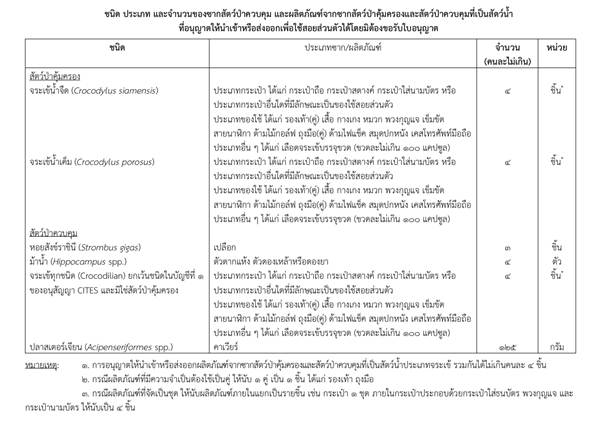
English Translation of the Table
Types and Quantities of Controlled Wildlife Carcasses and Products Derived from Controlled Wildlife and Aquatic Animals Classified as Wildlife Requiring a Permit to Bring In or Take Out for Personal Use
Controlled Wildlife
Siamese Crocodile (Crocodylus siamensis)
Maximum quantity: 4 pieces
Saltwater Crocodile (Crocodylus porosus)
Maximum quantity: 4 pieces
Crocodilian species listed in CITES Appendices and classified as controlled wildlife
Maximum quantity: 4 pieces
Remarks
Thai Customs
CITES Thailand (Department of National Parks, Wildlife and Plant Conservation)
Example Case:
✅ You Bought a Crocodile Bag in Thailand with a Tourist CITES Export Permit from Bangkok Bootery
Thailand Requirement:
You must obtain a CITES tourist export permit, which Bangkok Bootery will provide (especially for purchases over 5,000 THB).
✔️ This is mandatory and should accompany the product.
Germany (EU) Requirement:
Germany follows EU CITES regulations, which are stricter than many countries.
For CITES Appendix I species (e.g. Siamese crocodile – Crocodylus siamensis), you need:
🔹 CITES export permit from Thailand
🔹 CITES import permit issued by Germany – even for personal use.
For CITES Appendix II species (e.g. Nile or Saltwater crocodile – Crocodylus niloticus, C. porosus) used in fashion products:
🔹 Only CITES export permit from Thailand is needed
🔸 No import permit is required for personal use, but customs may inspect it.
🐊 CITES Listings for Common Crocodile Species
CITES categorizes species into three appendices based on their conservation status and the level of protection they require:
Appendix I: Species threatened with extinction. Commercial trade is generally prohibited.
Appendix II: Species not necessarily threatened with extinction but may become so if trade is not regulated. Trade is allowed but controlled through permits.
Appendix III: Species protected in at least one country, which has asked other CITES Parties for assistance in controlling trade.
Common Crocodile Species in Trade:
Siamese Crocodile (Crocodylus siamensis)
CITES Listing: Appendix I
Implication: Commercial trade is prohibited.
Reference: CITES Species Database
Saltwater Crocodile (Crocodylus porosus)
CITES Listing: Appendix I, except for populations in Australia, Indonesia, and Papua New Guinea, which are listed in Appendix II.
Implication: Trade from Appendix II populations is permitted with proper documentation.
Reference: CITES Species Database
Nile Crocodile (Crocodylus niloticus)
CITES Listing: Appendix I, except for populations in Botswana, Egypt, Ethiopia, Kenya, Madagascar, Malawi, Mozambique, Namibia, South Africa, Uganda, the United Republic of Tanzania, Zambia, and Zimbabwe, which are listed in Appendix II.
Implication: Trade from Appendix II populations is permitted with proper documentation.
Reference: CITES Species Database
https://checklist.cites.org/#/en/search/scientific_name=Crocodylus%20niloticus